🏛 IEEPA tariffs will cost households $1,300 annually
Trade Tracker #2

On Wednesday, the Supreme Court will hear arguments on whether President Trump overstepped his authority under the International Emergency Economic Powers Act (IEEPA) to impose sweeping new tariffs on most US trading partners.
My latest podcast episode at Tax Foundation breaks down how the Court’s decision could shape prices, tax revenues, and presidential tariff authority.
IEEPA tariffs as of Nov. 1, by the numbers:
+13 percentage points in the applied tariff rate, which previously stood at 1.5 percent.
+8 percentage points in the effective tariff rate, which accounts for behavioral changes and previously stood at 2.5 percent.
$88 billion paid by US importers in IEEPA tariffs so far this year.
$1.8 trillion in projected tax revenue from 2025–2034.
-0.4% long-run GDP and -428,000 jobs, before any foreign retaliation.
$1,300 cost per US household each year, on average.
In short, the IEEPA tariffs amount to one of the largest tax increases in US history—implemented without congressional approval.
The figures, drawn from Tax Foundation modeling, were cited in four amicus briefs opposing the tariffs before the Court.
Meanwhile, several economic and legislative developments are unfolding:
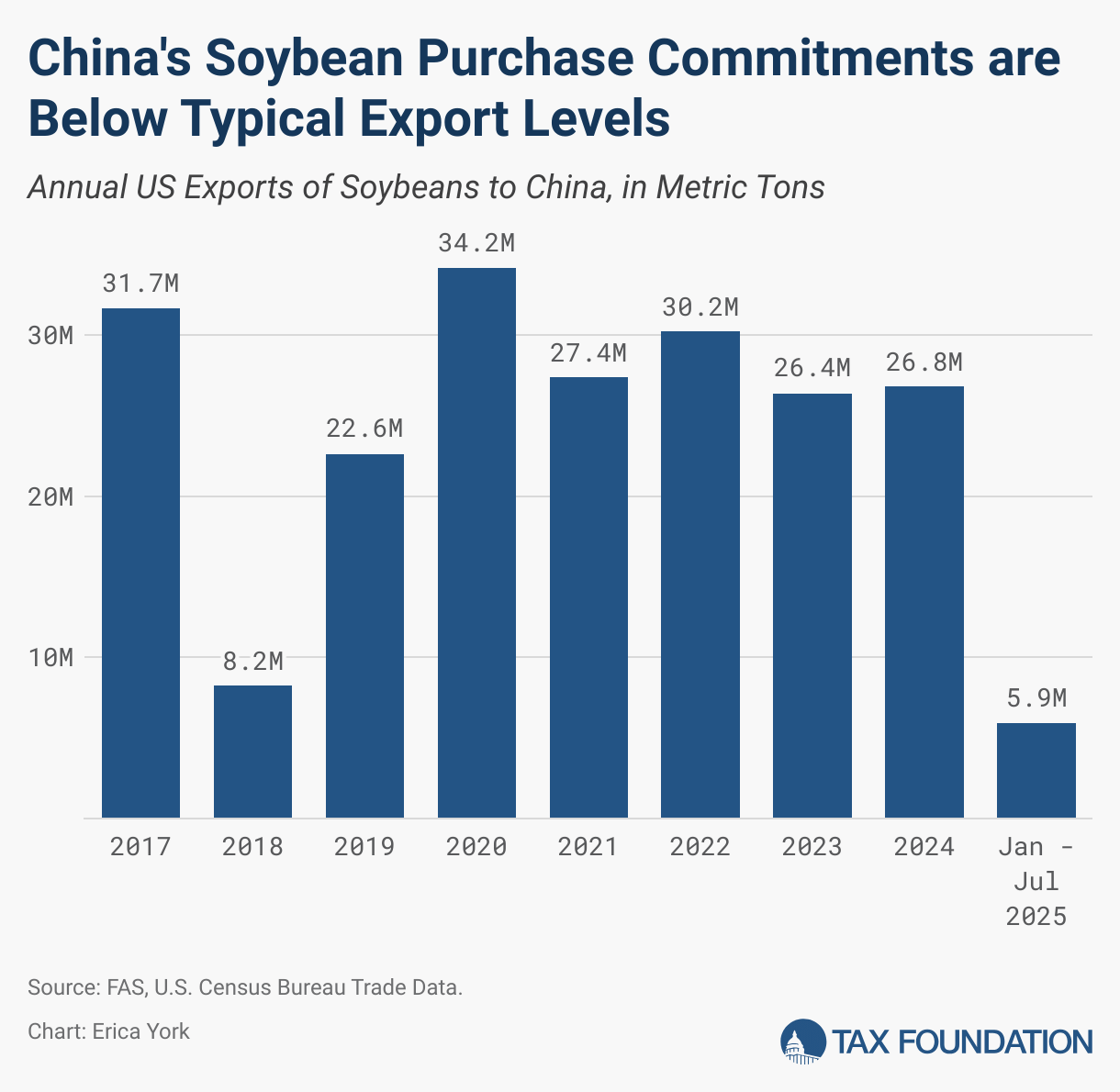
Agriculture exports and farmer bailout: Through early September, China had made no purchases of new-crop soybeans, compared to 6.5 million metric tons (mmt) at the same point last year. Following the Trump-Xi talks, China agreed to purchase 12 mmt this year and 25 mmt annually for the next three years—amounts that fall below the five-year average. If purchases return to typical levels, lawmakers may pare back the farmer aid package.
Tariffs and inflation: Economists at the St. Louis Fed estimated tariffs added 0.5 percentage points to headline PCE inflation through August. A separate team of academic economists estimated tariffs have added 0.7 percentage points to headline CPI inflation through September. That’s consistent with Fed Chair Powell’s remarks last week that “higher tariffs are pushing up prices in some categories of goods, resulting in higher overall inflation.”
Senate votes against certain tariffs: The Senate approved three resolutions terminating national emergencies used to impose certain tariffs. 🇨🇦 S.J. Res. 77 against the Canada tariffs passed 50-46, 🇧🇷 S.J. Res. 81 against the Brazil tariffs passed 52-48, and 🌎 S.J. Res. 88 against the global tariffs passed 51-47. While the resolutions would still need to pass the House and garner veto-proof majorities to take effect, they signal growing bipartisan impatience with the current tariff regime. Congress has the power to end the trade war—and should exercise it.