
August Trade Data Shows 11.1% Effective Tariff Rate
Trade Tracker #5

This might be the week that the China trade deal is finally finalized. The President has announced that China is resuming grain purchases, but not all grains are moving. Just look at the sorghum piles in my home state of Kansas.
While watching for progress on the exports front, newly released data from the Census Bureau shows:
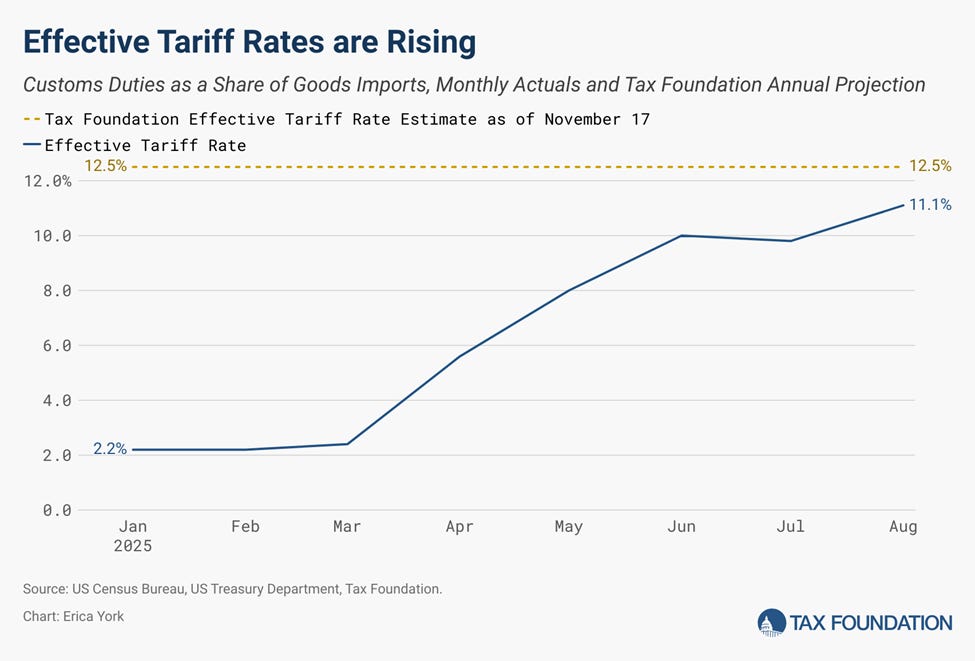
The effective tariff rate in August reached 11.1 percent.
Goods imports fell 6 percent from July, as the “Liberation Day” tariffs took effect August 7.
As more data on trade flows and tariff revenue becomes available, three points are important to keep in mind:
Tariffs change the level of trade—not its balance.
Tariffs discourage imports, but because they cause the US dollar to appreciate, they also discourage exports. The result is less trade overall, not a change in the trade balance. Other factors, like the US losing attractiveness as an investment location, could affect the balance. Interpreting the coming data will require caution: tariffs should result in less trade, they shouldn’t fundamentally change its balance.
The effective tariff rate will be lower than the applied tariff rate.
Tax Foundation estimates the statutory tariff rates applied to specific goods from specific countries, assuming no changes in import behavior, at 17.6 percent under the President’s tariffs.
But behavior will change. Some importers won’t comply. Some importers will buy less. That’s why the effective tariff rates—estimated tariff revenues as a share of estimated goods imports—is lower. We estimate it at 12.5 percent after behavioral adjustments
Tariffs alone don’t raise the price level.
Tariffs raise relative prices of taxed goods, reduce income, and lower employment. In response, the Fed may loosen policy to avoid a rise in unemployment from tariffs, which would raise the price level. So, tariffs should be expected to raise the prices of tariffed goods; what happens to the overall inflation picture depends on monetary policy.
In case you missed it: The Congressional Budget Office updated its tariff revenue estimates. They now find $2.5 trillion raised over 11 years (2025-2035), down from $3.3 trillion previously. The update reflects new data, tariff policy changes between August 19 and November 15, and a new assumption that foreigners will bear 5 percent of the increase in tariff rates. That brings CBO’s estimates closer to Tax Foundation’s estimate of $2.3 trillion over 10 years (2025-2034).